Hotel Group Sales RFP Playbook: Win More Corporate Events
A corporate planner sends 10 RFPs on Friday afternoon. Two hotels reply in 5 minutes with ballroom specs and open dates. Yours replies Monday. Here's a copy-paste playbook to fix that.

The Hotel Group Sales RFP Playbook: Respond Faster, Win More Corporate Events
TL;DR: What You'll Learn
- The math on slow RFPs: A single 200-person corporate event is worth $70,000+ in room blocks, F&B, and AV revenue. Respond 60 hours late and you won't even get a shot at it.
- The 3-channel audit: Score your hotel's response speed across website RFP forms, direct email, and phone inquiries - most properties leak leads in at least two.
- The 5-5-5 framework: Acknowledge in 5 minutes, include 5 key facts, follow up 5 times. Copy-paste templates included.
- When to automate: A decision matrix for choosing manual, hybrid, or fully automated RFP response based on your inquiry volume and team size.
What a $45,000 Group Booking Loss Actually Looks Like
Here's a breakdown most hotel sales teams never calculate.
A regional tech company needs a 2-day conference for 200 attendees. They submit RFPs to eight hotels within a 30-mile radius on Thursday evening. The typical revenue from this single booking:
| Revenue Line | Conservative | Mid-Range |
|---|---|---|
| Room block (80 rooms x 2 nights x $189) | $30,240 | $30,240 |
| F&B (200 pax x $85/day x 2 days) | $34,000 | $34,000 |
| AV and meeting room rental | $3,500 | $8,000 |
| Ancillary (parking, spa, bar) | $2,800 | $5,500 |
| Total | $70,540 | $77,740 |
Two hotels respond within 10 minutes with ballroom capacity, available dates, and a link to schedule a site visit. Your sales team sees the RFP Monday morning. By then, the planner has already booked two site visits and is comparing proposals from the fast responders.
You didn't lose because of price or location. You lost because of 60 hours of silence.
Research backs this up: contacting a lead within 5 minutes makes you 21x more likely to qualify them. Wait 30 minutes, and your odds drop by 100x. The average business takes 42 hours to respond to a web lead. For a hotel sales team juggling existing accounts, events in-house, and site visits, 42 hours is optimistic.
The 3-Channel Leak Audit: Score Your Hotel
Group and corporate leads arrive through three primary channels. Most hotels leak revenue in at least two. Score your property (1 point = yes, 0 = no).
Channel 1: Website RFP Forms
- New RFP submissions trigger an instant notification to the sales team (not just an email that sits in a shared inbox)
- A personalized acknowledgment goes out within 5 minutes of submission
- The acknowledgment includes at least 3 relevant details (capacity, sample menus, available dates)
- Weekend and after-hours submissions get the same response speed as weekday ones
- You track time-to-first-response for every RFP submission
Your score: ___ / 5
Channel 2: Direct Email Inquiries
- The sales inbox has a designated owner who checks it at least every 30 minutes during business hours
- Template responses exist for the 5 most common inquiry types (corporate meetings, weddings, social events, room blocks, holiday parties)
- Email leads receive a response within 1 hour, not 12
- After-hours emails get an automated acknowledgment with next-step information
- Leads that don't reply within 48 hours enter a follow-up sequence
Your score: ___ / 5
Channel 3: Phone Inquiries
- Calls to the sales line are answered by a person (or AI) - never voicemail during business hours
- After-hours calls get a live response, not a "leave a message" prompt
- Caller information (name, event type, dates, size) is captured in a CRM, not on a sticky note
- A follow-up email with relevant info goes out within 30 minutes of every call
- You track how many sales calls go to voicemail per week
Your score: ___ / 5
Scoring:
- 12-15: Your response infrastructure is strong. Focus on consistency and follow-up.
- 7-11: You're leaking revenue in at least one channel. The 5-5-5 framework below will help.
- 0-6: You're likely losing 30-40% of group leads to faster competitors. Start with the highest-volume channel first.
The 5-5-5 Response Framework: Templates You Can Use Today
The gap between hotels that win corporate business and those that don't isn't the property itself - it's the first 48 hours of communication. This framework closes that gap.
First 5: Acknowledge in 5 Minutes
Whether the lead arrives by form, email, or phone, send a personalized acknowledgment within 5 minutes. Not a generic "thanks for reaching out" - a response that proves you read their inquiry.
Copy-paste email template (customize the brackets):
Subject: Re: [Event Name] - [Hotel Name] Has Availability for [Date Range]
Hi [First Name],
Thanks for considering [Hotel Name] for your [event type]. I pulled a few details for you:
- Our [Ballroom/Meeting Space Name] seats [X] guests in [setup style] and [Y] in [alternative setup]
- We have availability on [Date 1] and [Date 2] - I've held a tentative block for you
- [One specific detail from their RFP, e.g., "We do offer AV packages that include projectors and wireless mics"]
Want to schedule a 20-minute site visit? Here are a few open slots: [Calendar Link]
I'll follow up [tomorrow/Friday] if I don't hear back.
[Your Name] [Direct Line]
Second 5: Include 5 Key Facts
Every initial response should answer the planner's unspoken questions. Include these five:
- Capacity for their specific event size and format
- Date availability (even if tentative)
- One differentiator (complimentary AV, on-site catering, free parking, rooftop access)
- Pricing range or "starting at" number (planners hate "call for pricing")
- Next step with a specific action (calendar link, site visit offer, proposal timeline)
Third 5: Follow Up 5 Times
Most hotel sales teams make 1-2 follow-up attempts. Data shows that 6 attempts achieve a 93% contact rate. Here's a 5-touch sequence:
| Touch | Timing | Channel | Message |
|---|---|---|---|
| 1 | 5 minutes | Initial acknowledgment with facts (template above) | |
| 2 | 24 hours | "Just making sure this landed - any questions about capacity or dates?" | |
| 3 | Day 3 | Phone | Brief voicemail: "Following up on your [event type] inquiry. Happy to walk through our options." |
| 4 | Day 5 | Share a case study or photo gallery: "Here's what a recent [similar event] looked like at our property." | |
| 5 | Day 10 | Final check-in: "Still exploring venues? I've kept your tentative hold. Let me know if dates shifted." |
Stop the sequence when the planner replies, books, or asks to be removed.
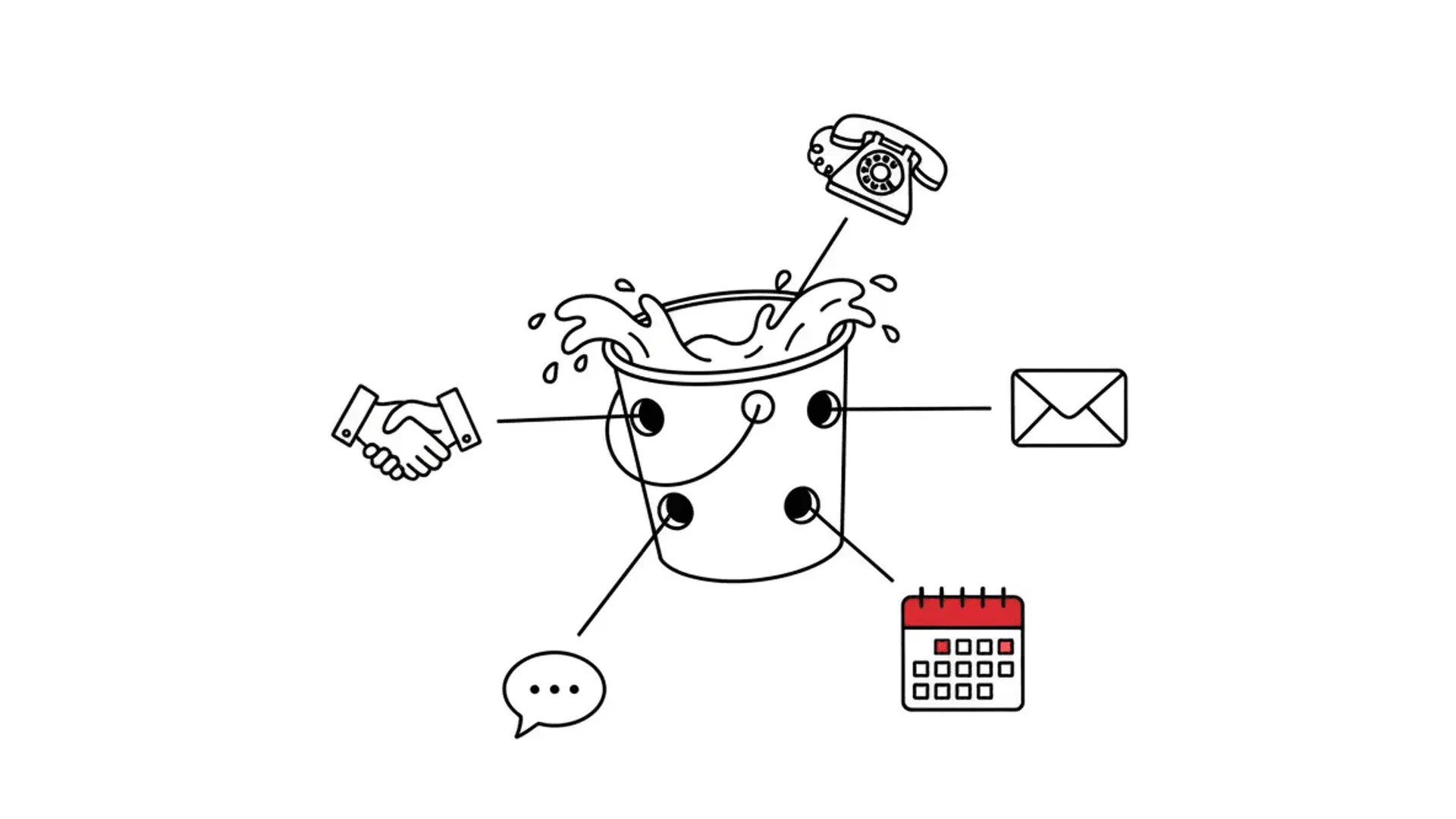
How an AI Sales Assistant Plugs Each Leak
The 5-5-5 framework works. The problem is execution. Your sales team can't monitor three channels 24/7, respond in 5 minutes at midnight, and run a disciplined 5-touch sequence for every lead while also managing in-house events and existing accounts.
This is a system problem, not a people problem. Here's how automation solves each piece:
Leak: Website RFP forms go unanswered for hours An AI Sales Assistant for hotels monitors your RFP inbox and responds within minutes - including after-hours, weekends, and holidays. It pulls answers from your uploaded sales kits, floor plans, and catering menus to provide accurate, property-specific responses.
Leak: Direct emails buried in a crowded inbox All email inquiries funnel into a unified dashboard alongside form submissions and call logs. No lead gets buried because every channel lives in one place. The AI reads each inquiry, qualifies the lead on event size, dates, and budget, then responds or escalates.
Leak: Phone calls going to voicemail The AI answers the phone with instant pickup, qualifies the caller, answers basic questions from your knowledge base, and books site visits by checking your team's real-time calendar availability. 85% of callers who reach voicemail won't call back - so live answering is critical.
Leak: Follow-up sequences that die after one attempt The AI runs the full 5-touch follow-up sequence automatically. It follows up via email and SMS on a schedule, personalizes each message based on the original inquiry, and stops when the planner responds or books.
Decision Matrix: Manual vs. Hybrid vs. Fully Automated
Not every hotel needs the same level of automation. Use this matrix to decide:
Choose manual response if:
- You receive fewer than 10 group inquiries per month
- You have a dedicated sales coordinator who monitors all channels during business hours
- Your average response time is already under 30 minutes
- You don't need after-hours or weekend coverage
Choose hybrid (AI handles first response, humans close) if:
- You receive 10-40 group inquiries per month
- Your team handles sales calls, site visits, and events simultaneously
- You want 24/7 coverage but prefer human-led proposal discussions
- Your response time is inconsistent - sometimes 10 minutes, sometimes 10 hours
Choose fully automated response if:
- You receive 40+ group inquiries per month
- Leads arrive from 3+ channels (forms, email, phone, OTAs)
- You're losing leads to after-hours and weekend gaps
- Your sales team spends more time on initial responses than on closing
Most hotels with active group sales programs fall into the hybrid category. The AI handles the speed-critical first response and follow-up, while your team focuses on proposals, site visits, and closing.
What Mikla actually does for hotels
Mikla is an AI Sales Assistant (sometimes called an AI receptionist) built for venues and hospitality businesses. Here is what it handles for hotels specifically:
- Every channel, one brain. Replies on email, SMS, voice calls, website chat, Instagram and Facebook DMs, WhatsApp, and marketplace lead forms (The Knot, WeddingWire, Hitched, Zola). Same memory across all of them, so a couple emailing Monday and texting Friday is treated as one conversation.
- Books directly on your calendar. Books, reschedules, and cancels appointments on Google Calendar or Outlook. Reads conflicts across your main calendar, Calendly, and any reserved sub-calendars before offering times. Handles in-person and virtual tours and generates Google Meet links automatically.
- Trained from your own documents. Upload your pricing sheets, contracts, and policies. Mikla trains itself in 2 to 5 minutes. Quick-edit the knowledge base in plain English ("change Friday hours to 6-11pm") with auto-rollback on failure. Refuses to fabricate pricing or capacity it does not know.
- Per-event-type configuration. Run weddings, corporate events, and private celebrations side by side, each with its own qualification questions, knowledge base, signature, follow-up cadence, and CTA. Add a new event type without writing code.
- Multi-stage follow-up automation. Email and SMS sequences across pre-tour, post-tour, and post-contract-sent stages. Auto-stops the moment a lead replies, books, or opts out. Detects natural opt-outs ("please stop"), not just STOP keywords. Respects quiet hours and your timezone.
- Built-in sales Kanban. Every lead moves through stages: new, qualified, tour booked, tour completed, contract sent, signed, lost. Conversations, qualification answers, calendar bookings, and follow-up history all live on the same lead. No separate CRM needed.
- Contracts and payments in the same flow. Once a booking is confirmed, Mikla fills your own contract template with the names, dates, and totals (your wording, never invented), sends it for built-in e-signature, and collects the deposit or payment schedule through Stripe. Signature and balance reminders run until it is signed and paid, then stop.
- 24/7 voice agent. Picks up calls in a natural human voice. Qualifies leads, answers questions, books tours, transfers to your team when appropriate. Full transcripts saved.
- Recognizes returning customers. Detects repeat inquirers and existing clients automatically. Marketplace leads parsed so couples are never re-asked for info they already filled in.
Frequently Asked Questions
Our RFPs require custom proposals with detailed pricing. Can AI handle that? The AI doesn't write final proposals. Its job is the speed-critical first 5 minutes: instant acknowledgment, answering initial questions (capacity, dates, AV options), and booking the discovery call. Your sales manager still owns the custom proposal - they just walk into it with a pre-qualified, engaged planner instead of a cold lead.
We already use a CRM. Does this replace it? No. An AI Sales Assistant works alongside your CRM. Lead data, conversation transcripts, and qualification details sync automatically. Think of it as the front door that feeds qualified leads into your existing sales workflow.
How does the AI know our specific room capacities, packages, and policies? You upload your own documents - sales kits, floor plans, catering menus, policy PDFs. The AI answers exclusively from your materials. When you update a document (new seasonal pricing, renovated ballroom capacity), upload the new version and the knowledge base updates instantly.
What about leads from OTAs and third-party platforms like Cvent? The AI monitors the email inbox where platform notifications arrive. When a new RFP lands from any source, it reads the submission and triggers the response sequence - same speed, same quality, regardless of where the lead originated.
Ready to see how Mikla handles your inquiries?
Book a 15-minute demo and we will connect Mikla to a test inbox of yours, upload your pricing sheet, and show you the AI replying to a sample inquiry in real time. No commitment, no card required.
Never miss another lead with Mikla's 24/7 AI sales agent.