HoneyBook vs Tripleseat (2026): Which Is Right for Your Venue?
HoneyBook runs a solo vendor's client work. Tripleseat runs a venue's booked events. Here is an honest 2026 comparison of pricing, features, and fit, plus the job neither one does.

HoneyBook vs Tripleseat (2026): Which Is Right for Your Venue?
An honest comparison of two very different platforms, and the question that decides it: what shape is your business?
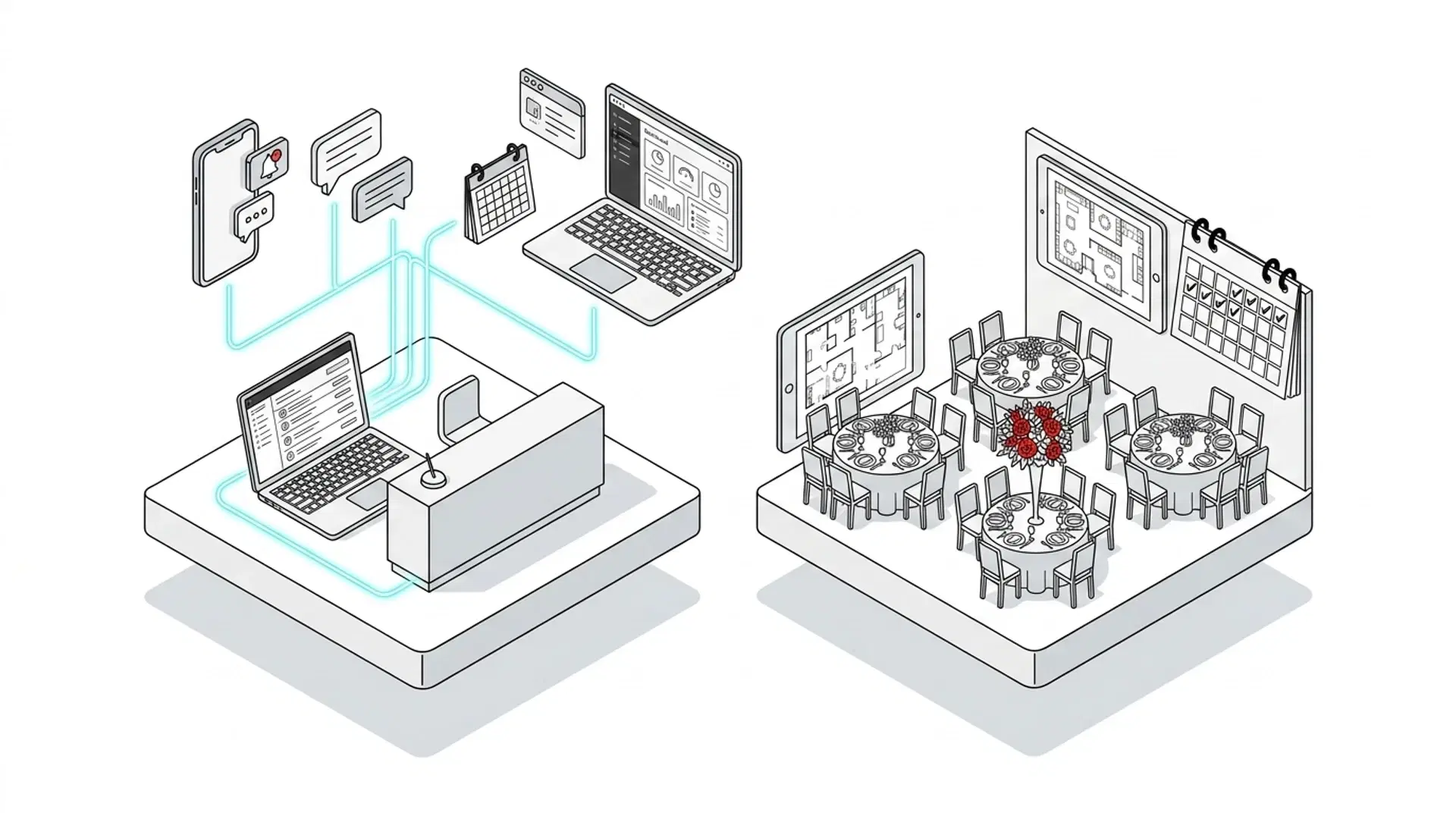
If you are comparing HoneyBook and Tripleseat, you are probably somewhere in between the two businesses they were built for. HoneyBook is clientflow software designed around one independent professional managing a handful of clients at a time. Tripleseat is an event management platform designed around a venue or restaurant executing a calendar full of booked events. They overlap on proposals, contracts, and payments, which is why they end up in the same shortlist, but they are built for different shapes of business. This guide breaks down where each one wins, what each one costs in 2026, and the one job neither of them does.
TL;DR
- HoneyBook is client management for independents. Proposals, contracts, invoices, scheduling, and a client portal, built first for solo vendors like photographers and planners. Published pricing runs $36 to $129 per month billed monthly, plus 2.9% + 25 cents per card payment.
- Tripleseat is event operations for venues. BEOs, 2D and 3D floor plans, F&B management, event CRM, and payments, used by more than 20,000 restaurants, hotels, and venues. Pricing is quote-based and not published.
- The decision is about your shape, not a feature count. A solo wedding vendor will drown in Tripleseat. A venue running forty events a month will outgrow HoneyBook fast.
- Neither one answers your inquiries. In both platforms, a person still reads every new lead and writes every reply. If slow or after-hours response is where you lose bookings, that is a different category of tool: an AI sales assistant.
What each platform actually is
HoneyBook calls itself clientflow software, and that is accurate. Its job starts once someone wants to work with you: send a branded proposal, get the contract signed, invoice, collect payment, and keep the whole project organized in a client portal. It serves photographers, planners, coaches, designers, and dozens of other independent service businesses. Venues can use it, but the product's center of gravity is one person running their whole business from one tool.
Tripleseat is an event management platform, and it has been the default for restaurants, hotels, and event venues since 2008. Its job starts once an event is on the books: build the banquet event order your kitchen works from, lay out the room in 2D or 3D, send the proposal, collect the deposit through PartyPay, and track the event to completion. It is a system of record for venues whose business is a high volume of complex events.
Put simply: HoneyBook manages clients, Tripleseat manages events. The overlap in proposals and payments hides how differently they think.
HoneyBook vs Tripleseat at a glance
| Capability | HoneyBook | Tripleseat |
|---|---|---|
| Built for | Solo and small independent businesses | Restaurants, hotels, and event venues |
| Core job | Clientflow: proposals, invoices, payments, portal | Event execution: BEOs, floor plans, F&B, event CRM |
| Proposals and contracts | Yes, polished and template-driven | Yes, event-focused with e-signature |
| Payments | Built in, 2.9% + 25 cents per card transaction | PartyPay |
| Invoicing and bookkeeping | Yes, including QuickBooks integration | Event billing, less bookkeeping depth |
| BEOs, floor plans, F&B management | No | Yes, and deep |
| Room blocks and hotel group sales | No | Yes |
| New inquiry handling | Form capture, AI-drafted replies your team reviews | Lead forms with templated auto-replies |
| Learning curve | Light, built for one person | Real ramp, built for teams, per G2 and Capterra reviewers |
| Pricing | Published: $36, $59, $129 monthly ($29, $49, $109 annual) | Quote-based, add-ons can raise the total |
Where HoneyBook wins
Simplicity and cost for small operations. HoneyBook is genuinely easy to run alone. One subscription covers proposals, contracts, invoices, scheduling, and payments, at a published price a small business can budget for.
Client experience across a long engagement. The branded client portal gives each client one place for files, messages, invoices, and payments. For a planner working with a couple over ten months, that polish matters.
Bookkeeping depth. Recurring invoices, payment plans, expense tracking, and a QuickBooks integration make HoneyBook the stronger back office for an independent business.
Where Tripleseat wins
Event execution at venue scale. BEOs your kitchen can actually work from, floor plans, menu and F&B management, and an event calendar built for dozens of simultaneous bookings. HoneyBook has no answer for any of this.
Team workflows. Tripleseat assumes a sales manager, an event manager, and operations staff all touching the same event. HoneyBook assumes one person.
Hotels and multi-space venues. Room blocks, group sales, and multi-room scheduling are native Tripleseat territory. If you run a hotel or a venue with several event spaces, HoneyBook was never designed for you.
The tradeoffs are real too. Tripleseat does not publish pricing, so you are quoting a custom package, and reviewers on G2 and Capterra mention a steep learning curve and occasional email deliverability problems where contracts land in guest spam folders. It is a platform you commit to, not one you casually adopt.
Who should pick which
Pick HoneyBook if you are a solo vendor or a team of one or two, your events are simple from an operations standpoint, and your real need is professional proposals, contracts, and getting paid without chasing invoices.
Pick Tripleseat if you run a restaurant, hotel, or dedicated event venue where the hard part is executing booked events: kitchens working from BEOs, rooms that need floor plans, and a calendar that several people manage at once.
Pick neither alone if your bottleneck comes before any of that: inquiries going unanswered.

The gap neither one covers
Here is the part most comparisons skip. Both HoneyBook and Tripleseat start working after a lead is already engaged. Neither one holds the first conversation.
When an inquiry lands at 9 PM on a Saturday, HoneyBook captures it into a pipeline and its AI can draft a reply for your team to review in the morning. Tripleseat sends a templated auto-reply from your lead form. In both cases, the actual selling waits for a person: reading the inquiry, answering the pricing question, asking about guest count and date, and offering a tour time. Meanwhile the couple or the corporate planner has already heard back from the venue down the street.
That is the job Mikla does. Mikla is an AI sales assistant for venues and hospitality that replies to every inquiry in under a minute, 24/7, across email, phone, SMS, website chat, Instagram DMs, Facebook, and WhatsApp. It answers questions from your own pricing and policy documents, qualifies the lead, books the tour on your live calendar with automated appointment booking, and runs follow-up that stops the moment the lead replies. It also fills your own contract template, collects the deposit through Stripe with built-in e-signature via contracts and payments, so smaller venues can go from inquiry to signed without a second tool.
Mikla is not trying to be either of these platforms. It does not build BEOs or floor plans, and it does not do bookkeeping. Venues pair it in front of Tripleseat, or run it alongside HoneyBook, or use it on its own. The point is that inquiry conversion is its whole job, which is exactly the job HoneyBook and Tripleseat both leave to your team.
All three at a glance
| HoneyBook | Tripleseat | Mikla | |
|---|---|---|---|
| Category | Clientflow for independents | Event management for venues | AI sales assistant for venues |
| Job starts | When a client engages | When an event is booked | The moment an inquiry arrives |
| Who answers new inquiries | Your team, with AI-drafted suggestions | Your team, after a templated auto-reply | Mikla itself, 24/7 |
| Books tours automatically | No | Self-service booking widget | Yes, live calendar check |
| Contracts and deposits | Yes | Yes | Yes, your template plus Stripe |
| Event execution (BEOs, floor plans) | No | Yes | No |
| Pricing | Published monthly tiers | Quote-based | Transparent monthly |
Frequently asked questions
Is Tripleseat better than HoneyBook?
For a venue, restaurant, or hotel running a real volume of events, yes: Tripleseat is purpose-built for event operations and HoneyBook is not. For a solo vendor or very small team, HoneyBook is the better fit and far simpler to run. They are rarely true head-to-head competitors, which is why the comparison usually resolves by business type rather than features.
How much does Tripleseat cost per month?
Tripleseat does not publish pricing. Plans are quote-based and vary by venue size and modules, and add-ons can raise the monthly total. HoneyBook publishes its pricing: $36, $59, or $129 per month billed monthly, or $29, $49, and $109 on annual billing, plus 2.9% + 25 cents per card payment on every plan.
Can HoneyBook run a wedding venue or restaurant?
It can for a small venue run by one or two people with modest inquiry volume. Venue teams tend to outgrow it as event volume grows, because it has no BEOs, floor plans, or F&B tools, and every inquiry still needs a human reply. That is usually when venues start comparing Tripleseat and its alternatives.
Does either platform answer inquiries automatically?
Not conversationally. HoneyBook drafts replies for your team to review, and Tripleseat sends templated auto-responses from lead forms. If inquiries are going cold nights and weekends, that is the problem an AI sales assistant solves: see our full comparison of Mikla vs Tripleseat and the best HoneyBook alternative for venues.
The bottom line
HoneyBook and Tripleseat are both good software for the businesses they were built around. If you are an independent vendor, HoneyBook will feel made for you. If you are a venue executing complex events, Tripleseat will earn its quote. But if the revenue you are losing walks away in the first hour after an inquiry, neither one is the fix. Mikla answers, qualifies, and books those leads around the clock for wedding venues and restaurants, then hands your team deals that are already real. Book a free consultation to watch it handle your venue's actual inquiries live.
Never miss another lead with Mikla's 24/7 AI sales agent.