Best AI Sales Assistant for Restaurants (Private Events) 2026
We compared the 8 tools restaurants actually use in 2026 to handle private dining, buyouts, and catering inquiries, ranked by channel coverage, calendar booking, and accuracy.

Best AI Sales Assistant for Restaurants (Private Events) 2026
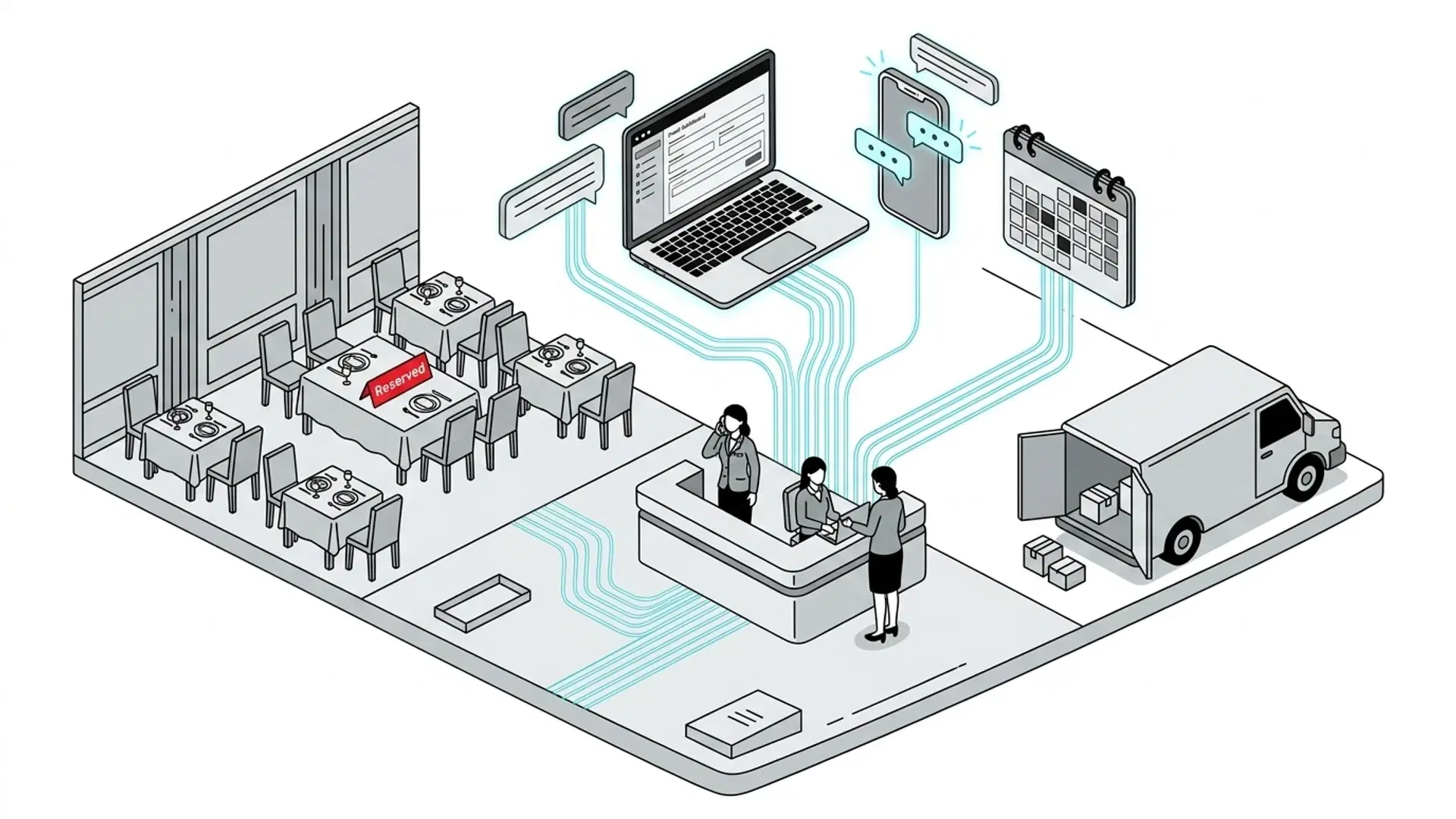
A side-by-side comparison of the 8 tools restaurants use to handle private dining, buyout, and catering inquiries, ranked by channel coverage, calendar booking, and how well they separate a $9,000 buyout from a Friday reservation.
TL;DR
- A restaurant private-events inbox is a separate business from the dining room: private dining bookings, full buyouts, and off-site catering, each with its own minimums, menus, and deposits. Most tools were built for the reservation, not the event.
- Mikla wins on channel coverage (including the phone the host stand cannot work as a sales line and Instagram DMs), separating high-value event leads from reservation noise, and document-trained answers about your private dining menus, room minimums, and deposit rules. Tripleseat and SevenRooms are excellent at what they do (event execution and reservations) but are not AI Sales Assistants.
- Smith.ai is strongest if you mostly want live humans on the phone. Generic chatbots and DIY ChatGPT break on calendar logic, room minimums, and pricing accuracy.
- The right setup for most restaurants: keep your reservation platform (OpenTable, Resy, SevenRooms) for covers, keep Toast for POS, keep Tripleseat for event execution, add Mikla as the AI Sales Assistant that responds to private-event inquiries across every channel.
What makes a restaurant private-events inbox different
A restaurant runs two businesses out of one kitchen. The dining room turns covers all night, and the private-events side sells a handful of high-value bookings a month that pay for the slow weeks. The inbox that handles those events looks nothing like the reservation book.
Three things make restaurant private events different from a hotel or a wedding venue:
- The high-value lead hides in reservation noise. For every private dining inquiry, the inbox gets dozens of "do you take walk-ins?" and "are you open Monday?" messages. A $9,000 buyout request and a two-top reservation land in the same place, and the buyout cannot wait until the GM checks email at midnight.
- The host stand is not a sales desk. Whoever answers the phone is seating guests and managing the waitlist mid-service. They are not positioned to qualify a corporate holiday party or quote a buyout minimum, and after close nobody answers at all.
- One restaurant sells three different event products. A semi-private dining room booking, a full restaurant buyout, and off-site catering each have different minimums, menus, deposits, and lead times. They cannot be answered with the same reply.
An AI Sales Assistant for a restaurant is software that handles a restaurant's inbound private-events workflow without a human in the loop: capturing private dining, buyout, and catering inquiries on any channel, qualifying the occasion and party size, answering from your own menus and minimums, and booking site visits or events on your calendar. Some vendors call this an AI receptionist. They refer to the same category.
What to look for in a restaurant AI Sales Assistant
Seven criteria decide whether a tool fits a restaurant's private-events business, in order of impact on revenue.
- Channel coverage including the phone and social DMs. Email is the floor. Voice matters because the host stand cannot work the phone as a sales line during service. Add SMS, website chat, Instagram and Facebook DMs, and WhatsApp, since event planners and locals increasingly reach out on social.
- Separating event leads from reservation noise. The tool must answer the walk-in and hours questions on its own and flag the private dining, buyout, or catering inquiry the moment it lands, so the GM only gets pinged for the leads worth real money.
- Per-event-type configuration. Semi-private dining, full buyouts, and off-site catering each need their own qualification questions, knowledge base, minimums, and follow-up. Adding a new product (a chef's table series, a holiday catering menu) should be a configuration change, not a developer ticket.
- Multi-space calendar booking. A restaurant has a private dining room, a semi-private section, a patio, and the full room for buyouts. The tool needs to book the right space on your calendar based on party size and event type, and read existing holds before offering a date.
- Knowledge base from your documents. Private dining menus, room minimums, deposit and cancellation policies, dietary accommodations, and catering packages. The tool must answer from your own documents and never invent a minimum or a policy.
- Multi-stage follow-up. A buyout or catering inquiry that does not convert on the first reply needs a follow-up sequence, not a single email that dies in a busy planner's inbox. Auto-stop on reply, booking, or opt-out.
- 24/7 voice agent. Corporate planners and hosts call during service and after. A voice agent that picks up every call, answers from your knowledge base, and books the site visit is the biggest win for a business whose phone is staffed by people running the floor.
Pricing model matters too, but it is downstream of fit. A restaurant-grade tool typically prices per location, not per call or per message.
The 8 tools compared
| Tool | Channels covered | Voice agent | Calendar booking | Lead vs reservation routing | KB from docs | Best for |
|---|---|---|---|---|---|---|
| Mikla | Email, SMS, voice, chat widget, Meta DMs, WhatsApp | Yes (24/7) | Google + Outlook, multi-space | Yes | Yes (no hallucination) | Multi-channel private events |
| Tripleseat | No | Yes | Limited | Structured fields only | Event execution and BEOs | |
| SevenRooms | Reservations widget, email | No | Reservations-native | Limited | Limited | Reservations and guest CRM |
| OpenTable / Resy | Reservations widget | No | Reservations-native | No | No | Cover reservations |
| Toast | POS, online ordering | No | No | No | No | Restaurant POS |
| Smith.ai | Voice, chat | Live humans | Yes | Manual | Light | Live phone coverage |
| Generic chatbots (Intercom Fin, Drift, Tidio) | Website chat | No | Limited | No | Partial | Generic SaaS, not restaurants |
| DIY ChatGPT build | What you build | No | What you build | What you build | Unreliable | The brave |
1. Mikla: best overall for restaurant private events
Mikla is an AI Sales Assistant purpose-built for venues and hospitality, including restaurants. It replies on every channel a planner uses (email, SMS, voice calls, website chat, Instagram and Facebook DMs, WhatsApp) from one AI brain that remembers the full conversation. A planner who calls during service Monday and emails the events address Friday is treated as one thread, not two cold starts.
Where it shines for restaurants:
- Picks up the phone 24/7 in a natural voice, the channel your host stand cannot work as a sales line, and qualifies the private dining, buyout, or catering lead from that call
- Answers the walk-in, hours, and menu questions on its own, and pings your GM only when a high-value buyout, corporate party, or catering order comes in
- Books private dining, buyouts, and site visits directly on Google Calendar or Outlook, routes events to the right space (private room, patio, full buyout) based on party size, and reads existing holds before offering a date
- Runs semi-private dining, full buyouts, and off-site catering side by side, each with its own qualification questions, knowledge base, minimums, signature, follow-up cadence, and CTA
- Trained from your own private dining menus, room minimums, deposit policies, and dietary accommodations. Refuses to fabricate a minimum or policy it does not know, forwarding unknowns to your team with full conversation context
- Multi-stage email and SMS follow-ups across pre-event, post-visit, and post-quote stages, with auto-stop on reply, booking, or natural opt-out
Where it falls short:
- Not a reservation platform or a POS. Mikla does not run the cover book or the register. It integrates alongside OpenTable, Resy, SevenRooms, and Toast rather than replacing them.
- Higher ticket than a generic chatbot. Right call for a restaurant with a real private-events business, possibly overkill for a spot that books one party a quarter.
Verdict: If your phone is staffed by people running the floor and you have lost a buyout to a slow reply, this is the strongest tool in the category.
2. Tripleseat: best for event execution and BEOs
Tripleseat is a category leader in catering and event management for restaurants, with strong tools for the events team.
Where it shines: BEO management, event delivery workflows, document and proposal handling, and a pipeline view once a deal is in flight.
Where it falls short as an AI Sales Assistant: Tripleseat manages the event after the inquiry is captured, not the multi-channel response that captures it. It does not pick up the phone with an AI voice, parse a free-text buyout email and start a contextual follow-up sequence, or answer open-ended questions from your own documents autonomously.
Verdict: Keep Tripleseat for BEOs and event execution. Pair it with an AI Sales Assistant for the inquiry-to-booking work upstream.
3. SevenRooms: best for reservations and guest CRM
SevenRooms is a reservations, seating, and guest-data platform used across hospitality, including private dining at larger restaurant groups.
Where it shines: reservation management, waitlists, guest profiles, and marketing to a known guest database.
Where it falls short for private events: SevenRooms is built around the reservation, not autonomous multi-channel private-event inquiry response. It does not pick up the phone with an AI voice, separate a buyout from a two-top, or answer open-ended menu and minimum questions from your own documents the way an AI Sales Assistant does.
Verdict: A strong reservations and guest-CRM layer. The open-ended private-event inquiry response is a separate job.
4. OpenTable / Resy: best for cover reservations
OpenTable and Resy are the dominant reservation platforms, getting diners into seats and onto your floor.
Where they shine: cover reservations, discovery, waitlists, and diner data for the dining room.
Where they fall short: these are reservation tools, not private-event sales tools. They do not reply to buyout inquiries, qualify a corporate party, handle the phone, or answer questions from your private dining menus.
Verdict: Keep OpenTable or Resy for covers. They fill the dining room; they do not handle the planner who wants to book the room out.
5. Toast: best for restaurant POS
Toast is a leading restaurant POS, covering payments, online ordering, and operations.
Where it shines: point of sale, online ordering, kitchen operations, and payments.
Where it falls short: Toast runs the register and the line, not the events inbox. It does not reply to private dining or catering inquiries, pick up the phone with an AI voice, or qualify event leads.
Verdict: Keep Toast for POS and ordering. The private-event inquiry response is a separate problem.
6. Smith.ai: best for live human phone coverage
Smith.ai is a virtual receptionist service backed by real human agents with AI augmentation. They answer your phone and chat widget and forward qualified leads to your team.
Where it shines: real humans on calls, helpful for a restaurant that wants a warm human voice on the first contact.
Where it falls short: pricing scales with call volume, which gets expensive when most calls are reservations and FAQ. They do not manage the events inbox the way an AI Sales Assistant does, do not parse Instagram or WhatsApp, and their knowledge of your private-events product depends on what their agents were briefed on.
Verdict: A solid call-answering supplement at low volumes. Not a replacement for the email and social side of private-event sales.
7. Generic AI chatbots (Intercom Fin, Drift, Tidio)
Generic AI chatbots live on your website chat widget and answer visitor questions from a knowledge base you upload.
Where they shine: SaaS support and website chat in general.
Where they fall short for restaurants: they live in one channel (website chat) and were not built for the private-events workflow. They do not pick up the phone, route a buyout to the right space, parse Instagram DMs, or handle the calendar, and they often hallucinate minimums if you upload a complex private dining PDF.
Verdict: Wrong tool for the job. A restaurant that drops one on its site is solving a different problem than the one it has.
8. Building your own with ChatGPT or Claude
GPT-class models are powerful enough that a technical operator might try to build a private-events AI by piping email and webhooks into an LLM.
Where it shines: full control over prompts, low raw API cost.
Where it falls short for restaurants:
- Calendar and multi-space logic is hard. The model does not natively check which rooms are free or route a 40-person party to the private room. Bugs in date logic cost you booked events.
- Knowledge base accuracy is unreliable. A naive setup will quote the wrong room minimum or the wrong deposit policy.
- Voice, SMS, Instagram, Facebook, and WhatsApp each need their own integration. Building all of them is a 6 to 12 month engineering project, plus maintenance.
- No lead-versus-reservation routing, no team handoff, no per-event-type config, no test mode.
Verdict: Tempting if you are technical and only need one channel. A real restaurant has an unstaffed sales phone, six channels, and a buyout hiding in dozens of reservation messages. DIY breaks at scale.
How to choose: a decision framework
- Choose Mikla if: your sales phone is staffed by people running the floor, you run more than reservations (private dining, buyouts, catering), you get meaningful Instagram traffic, or you have ever lost a buyout to a slow reply.
- Keep OpenTable, Resy, or SevenRooms for cover reservations. Add Mikla for the private-event inquiries they were not built to answer.
- Keep Toast (or your POS) for payments and ordering. Mikla owns the inquiry response side.
- Keep Tripleseat for BEOs and event execution. Mikla owns the inquiry-to-booking pipeline upstream.
- Use Smith.ai for live human phone coverage at low call volumes when human warmth matters more than scale.
- Skip generic chatbots and DIY ChatGPT for any restaurant doing real private-events revenue. The lost buyouts cost more than the savings.
What setup looks like for a restaurant
Most restaurant operators assume an AI Sales Assistant is a multi-month project. With a venue-built tool it is closer to an hour, broken into five steps:
- Connect your inboxes and social channels. One-click OAuth for Gmail or Outlook. Add as many inboxes as you need (events@, privatedining@, catering@, info@). Connect Instagram, Facebook Messenger, and WhatsApp so the AI replies from whichever channel the planner used.
- Forward your phone. Point the events line to the AI voice agent so the calls your host stand cannot work as a sales line get answered, qualified, and booked instead of going to voicemail.
- Connect your calendars. Pull in Google Calendar or Office 365, including holds for the private dining room, patio, and full buyouts, so the AI checks real availability before offering a date.
- Upload your documents. Private dining menus, room minimums, deposit and cancellation policies, dietary accommodations, and catering packages. The AI trains itself in 2 to 5 minutes and emails you when it is ready.
- Run test mode before going live. Preview exactly what the AI would send to incoming inquiries and say on the phone, edit, and approve before it starts replying to real planners.
Most restaurants are answering real calls and inquiries on the same day they set up.
What Mikla does for restaurants specifically
Mikla is an AI Sales Assistant (sometimes called an AI receptionist) built for venues and hospitality businesses. Here is what it handles for restaurant private events specifically:
- Every channel, one brain. Replies on email, SMS, voice calls, website chat, Instagram and Facebook DMs, and WhatsApp. Same memory across all of them, so a planner who calls Monday and emails Friday is one conversation.
- Answers the phone your floor staff cannot. A 24/7 voice agent picks up the events line in a natural human voice, answers from your knowledge base, books site visits, and transfers high-value buyout calls to your team with full context. Full transcripts saved.
- Separates buyouts from reservation noise. Handles the walk-in, hours, and menu questions on its own, and flags corporate parties, full buyouts, and catering orders the moment they arrive.
- Books the right space on your calendar. Books, reschedules, and cancels private dining and events on Google Calendar or Outlook. Routes a buyout to the full room, a small dinner to the private room, and reads existing holds before offering dates.
- Trained from your own documents. Upload private dining menus, room minimums, deposit policies, and dietary accommodations. Quick-edit the knowledge base in plain English with auto-rollback on failure. Refuses to fabricate a minimum or policy it does not know.
- Per-event-type configuration. Run semi-private dining, full buyouts, and off-site catering side by side, each with its own qualification questions, knowledge base, minimums, follow-up cadence, and CTA. Add a new product without writing code.
- Multi-stage follow-up automation. Email and SMS sequences across pre-event, post-visit, and post-quote stages. Auto-stops the moment a planner replies, books, or opts out. Respects quiet hours and your timezone.
- Built-in sales Kanban. Every event lead moves through stages: new, qualified, site visit booked, completed, contract sent, signed, lost. Conversations, qualification answers, bookings, and follow-up history live on the same lead.
- Contracts and payments in the same flow. Once a private event is confirmed, Mikla fills your own contract template with the names, dates, and totals (your wording, never invented), sends it for built-in e-signature, and collects the deposit or payment schedule through Stripe. Reminders run until it is signed and paid, then stop.
FAQ
What is an AI Sales Assistant for a restaurant?
An AI Sales Assistant for a restaurant is software that handles a restaurant's inbound private-events workflow automatically by capturing private dining, buyout, and catering inquiries on every channel (phone, email, Instagram and Facebook DMs, WhatsApp, website chat, SMS), answering the high-volume reservation and FAQ noise on its own, flagging high-value event leads, answering questions from your own menus and minimums, booking site visits and events on your calendar, and following up across the lifecycle. Some vendors call this an AI receptionist or AI lead response tool. They refer to the same category.
How is this different from OpenTable, Resy, or Tripleseat?
OpenTable and Resy are reservation platforms and Tripleseat is an event-management tool. All are strong at what they do, but none reply to private-event inquiries autonomously across every channel. Reservation tools fill the dining room; Tripleseat manages the event after it is booked. An AI Sales Assistant covers the open-ended buyout and catering inquiries that arrive by phone, email, and DM. Most restaurants keep their reservation platform, keep Tripleseat for execution, and add Mikla for the inquiry response neither was built for.
Can the AI answer my phone during service?
Yes. Mikla's 24/7 voice agent picks up the events line in a natural human voice, answers questions from your knowledge base, qualifies private dining and buyout leads, books site visits, and transfers high-value calls to your team with full context and a saved transcript. The calls that would have gone to voicemail while your host stand was seating guests get answered and converted instead.
How does the AI tell a buyout from a regular reservation?
Mikla reads the intent of every inbound message and call. Reservation and FAQ noise (walk-ins, hours, menu questions) gets answered automatically from your knowledge base. High-value signals (a party size, a buyout request, a corporate event, a catering order with a date and budget) trigger qualification and an immediate flag to your team, so you only get pulled off the floor for the leads worth real money.
What is the best answering service for a restaurant?
It depends on which calls you are trying to save. A traditional answering service staffs people to pick up your line, take a message, and email it to you, priced by the minute, which suits a restaurant that mostly needs someone to catch overflow calls politely. What it does not do is sell: a message taker cannot quote your buyout minimum, check whether the private room is free on October 12th, or book the site visit. For a restaurant with a real private-events business, an AI answering service is the better economics and the better outcome, because it picks up every call at once, answers from your own menus and minimums, and books the visit on your calendar instead of leaving you a callback slip. We compare the two models in detail in our AI answering service vs virtual receptionist breakdown, and rank the category in our guide to the best AI receptionists for venues and hospitality.
Do I need a separate answering service if I already have an AI sales assistant?
No. An AI sales assistant like Mikla includes the answering service as one of its channels rather than as a separate subscription. The same AI that replies to your email and Instagram inquiries also answers the phone 24/7 in a natural voice, handles the routine questions your host stand gets asked all night, and escalates a corporate holiday party or buyout call to your events lead with the full transcript attached. Paying separately for phone answering and inquiry response usually means two tools that do not share a memory, so the caller who phoned on Tuesday gets treated as a stranger when they email on Thursday.
Ready to see how Mikla handles your restaurant's private-event inquiries?
Book a 15-minute demo and we will connect Mikla to a test inbox of yours, forward a sample call, upload your private dining menu, and show you the AI replying in real time. No commitment, no card required.
Never miss another lead with Mikla's 24/7 AI sales agent.
14 days of Core. No card.